
Publisher inboxes often contain more submissions than an editor can deeply review on the day they arrive. A triage system can help sort work by review need—but the system should prioritize human attention, not issue automatic acceptance or rejection.
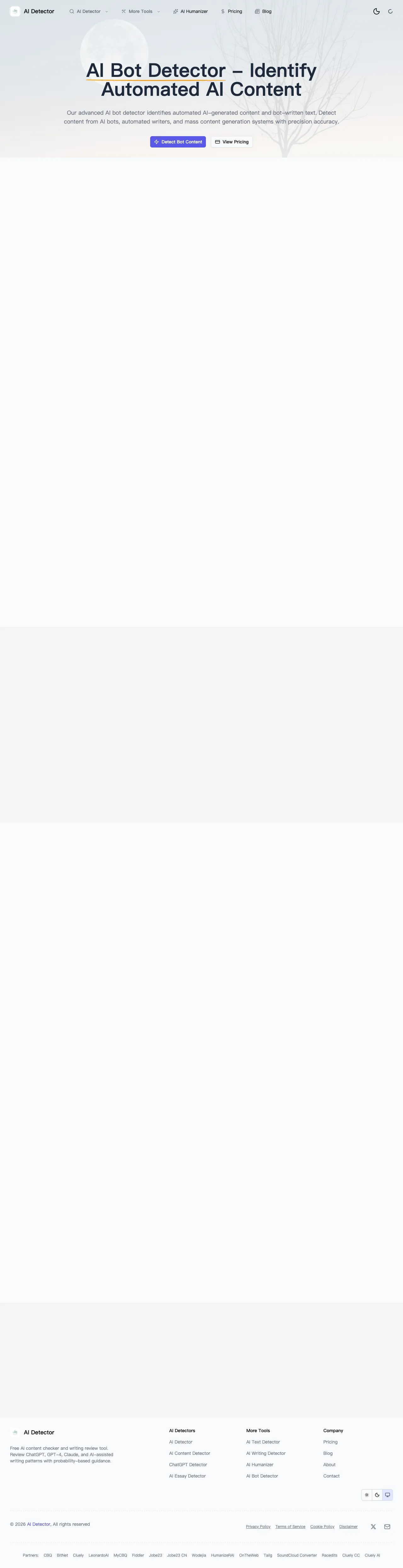
Product reference: the public AI Bot Detector page captured on July 19, 2026.
Last reviewed: July 19, 2026 Use case: managing a queue of guest posts, contributed articles, or community submissions
Design the queue around evidence gaps
Start with signals that relate to an editor's real work: missing author disclosure, unverified claims, absent references, duplicate pitch language, a mismatch with the publication's subject area, or a detector result that suggests a closer read. Each signal should have a clear human action attached to it.
| Queue label | Signal | Editor action |
|---|---|---|
| Ready for edit | Clear byline, sources, and fit | Assign a normal line edit |
| Needs source check | Claims lack primary links | Verify the highest-impact claims first |
| Needs author context | Generic expertise or unclear disclosure | Ask for reporting notes or examples |
| Needs escalation | Possible plagiarism or safety risk | Assign a senior editor and preserve evidence |
Worked example: prioritize, do not convict
Submission note: “This guide is based on the latest industry research,” followed by no named study, author, or date.
This is enough to route the piece to source check. It is not enough to state that the author used AI or acted in bad faith. The editor can request two primary sources, a description of the writer's experience, and a revision that makes the claim specific.
Keep the score out of the author-facing message
Authors benefit from concrete editorial requests: “Please link the report behind this statistic” or “Add an example from the workflow you describe.” They do not benefit from an unexplained numeric score. Internal review notes can record tool output where policy permits, but the conversation should focus on verifiable content quality.
Measure the system by editorial outcomes
Track how many queued items led to factual corrections, source additions, or successful publication. Also track how often a signal proved unhelpful. If a rule sends many good submissions into an expensive queue without improving quality, remove or adjust it.
This is the difference between useful automation and a decorative dashboard: every signal should lead to a bounded editorial task and a measurable outcome.