
Trust grows when readers can see who is responsible for a page, how important claims were checked, and why the content exists. That is especially useful for AI-assisted writing, where a polished surface can conceal a thin research process.
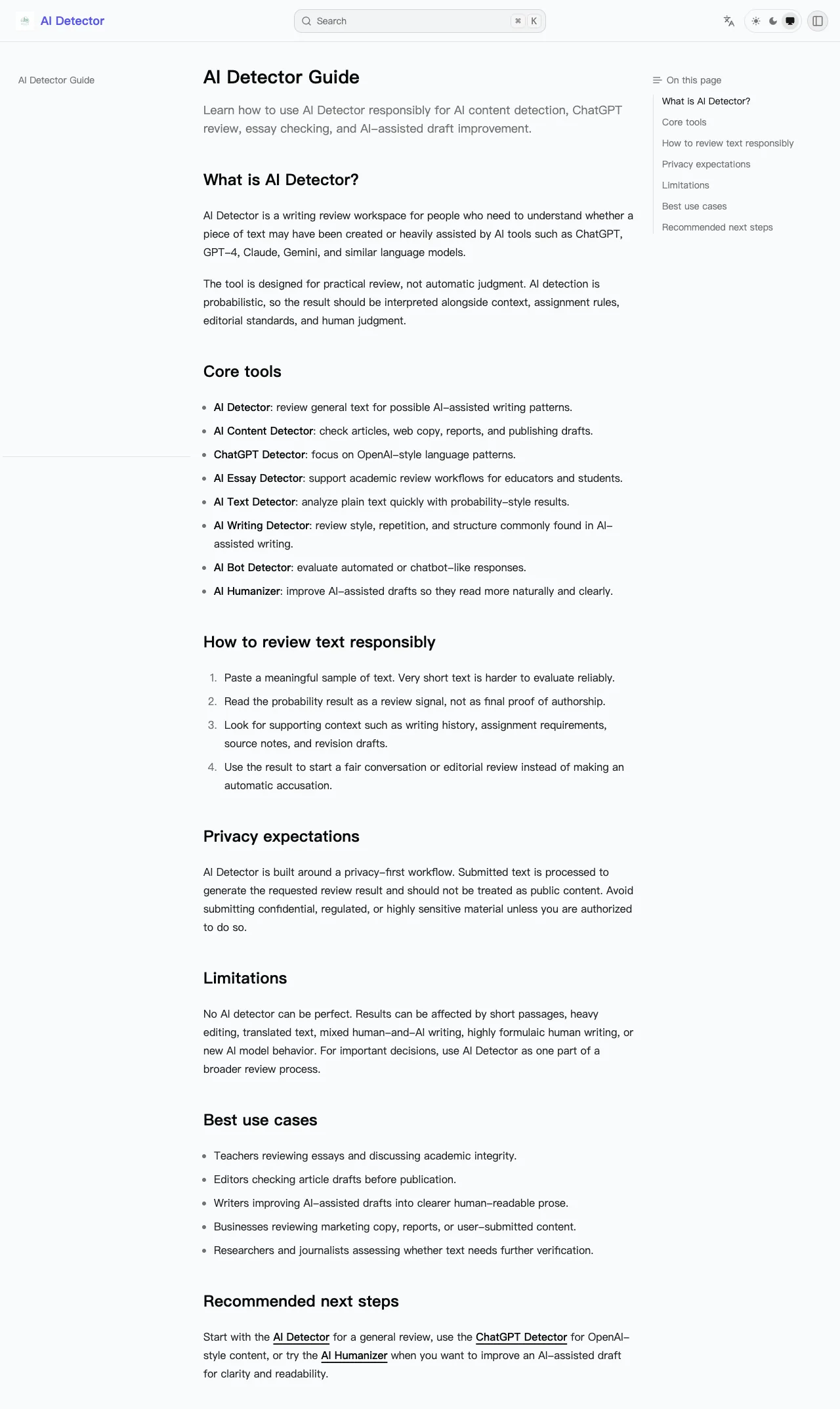
Product reference: the public documentation page captured on July 19, 2026.
Last reviewed: July 19, 2026 Use case: product documentation, guides, tutorials, and editorial knowledge bases
The minimum record for a high-value page
Add five pieces of information where they would help a reader evaluate the page:
- Owner: named author, editorial team, or accountable organization.
- Review date: when the information was last materially checked.
- Method: whether the piece includes tested steps, primary sources, interviews, or AI-assisted drafting.
- Evidence: links to primary sources, screenshots, datasets, or reproducible examples.
- Boundary: what the page does not prove or cover.
This is not bureaucratic overhead. It helps readers choose how much to rely on a page and helps the next editor update it without guessing.
Worked example: document a product comparison honestly
Weak note: “We tested the best AI detectors and found one clear winner.”
Useful note: “On July 19, 2026, we compared four tools on a 40-document pilot containing verified human, model-generated, and human-edited text. Results describe this test set only; they are not a universal accuracy ranking.”
The useful note names scope, date, method, and limit. It gives a reader enough context to decide whether the comparison applies to their situation.
Use screenshots as evidence, not decoration
A screenshot should show a real interface, date, and meaningful state. Its caption should explain what the reader is looking at. Do not crop a result to imply a performance claim that the full workflow cannot support. If the screenshot contains account data or personal text, redact it before publication.
Keep AI disclosure proportional
Not every spelling correction needs a banner. Disclose substantial AI involvement when a reasonable reader would ask how the content was made—for example, when automation generated a large draft, a comparison table, or a recommendation. Google recommends considering “who, how, and why” as a way to help readers understand content, including AI-assisted content.