
There is no single test that reveals the complete history of a piece of text. A practical review combines several imperfect signals: writing patterns, factual accuracy, source provenance, document history, and the author's explanation. The combination is more useful because each signal answers a different question.
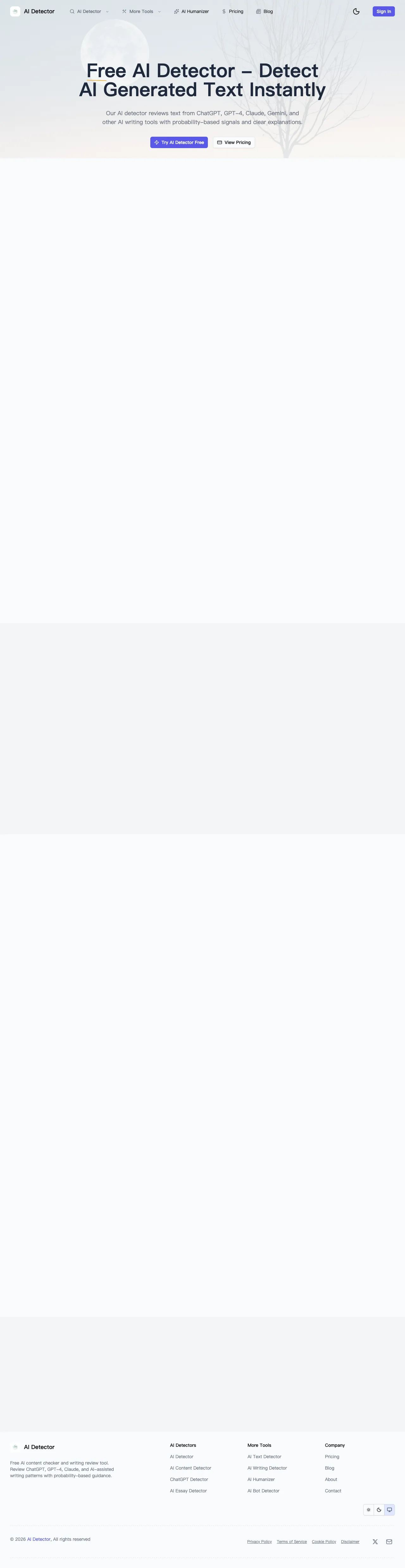
Product reference: the public AI Detector page captured on July 19, 2026.
Last reviewed: July 19, 2026 Use case: educators, editors, and reviewers building a responsible text-review workflow
What each method can tell you
| Method | Useful for | Not sufficient for |
|---|---|---|
| Text-pattern analysis | Routing unusually generic or patterned text for review | Proving who wrote a document |
| Source verification | Checking claims, quotes, and citations | Explaining every writing choice |
| Draft history | Understanding revision and process | Guaranteeing unaided authorship |
| Provenance metadata | Establishing signed assertions where available | Judging whether the content is true or good |
| Human conversation | Clarifying choices, evidence, and policy context | Replacing a consistent written process |
Use a short, reproducible review sequence
- Read the assignment, brief, or editorial standard.
- Identify concrete evidence gaps: missing sources, abrupt stylistic changes, or unverifiable claims.
- Use a detector only as a probability-based signal for where to look next.
- Verify sources and review available drafts or provenance.
- Ask targeted questions and record the human outcome.
Demonstration sample: a report cites an unnamed “2026 survey” and receives a high review signal. The first action is to locate the survey, not to accuse the author. If no source exists, the issue is factual support regardless of how the draft was produced.
Use provenance where it exists, with limits
C2PA Content Credentials can provide cryptographically verifiable assertions about creation and edits for supported media and tools. They are useful context, but they do not make a value judgment about whether the content is trustworthy or appropriate. Absence of credentials is not evidence of wrongdoing; many valid workflows do not yet produce them.
Calibrate to the stakes
For low-stakes editorial feedback, a detector can be one of several signals. For disciplinary, employment, or legal consequences, require stronger independent evidence, notice, human review, and an appeal path. The more a result can affect a person, the less appropriate it is to let a single automated score drive the outcome.