
Publishers do not need a binary “AI or human” rule to protect quality. The more useful question is whether a draft is accurate, attributable, useful to readers, and edited by someone accountable for it. AI detection can help route work for review, but the editorial standard remains the same for every draft.
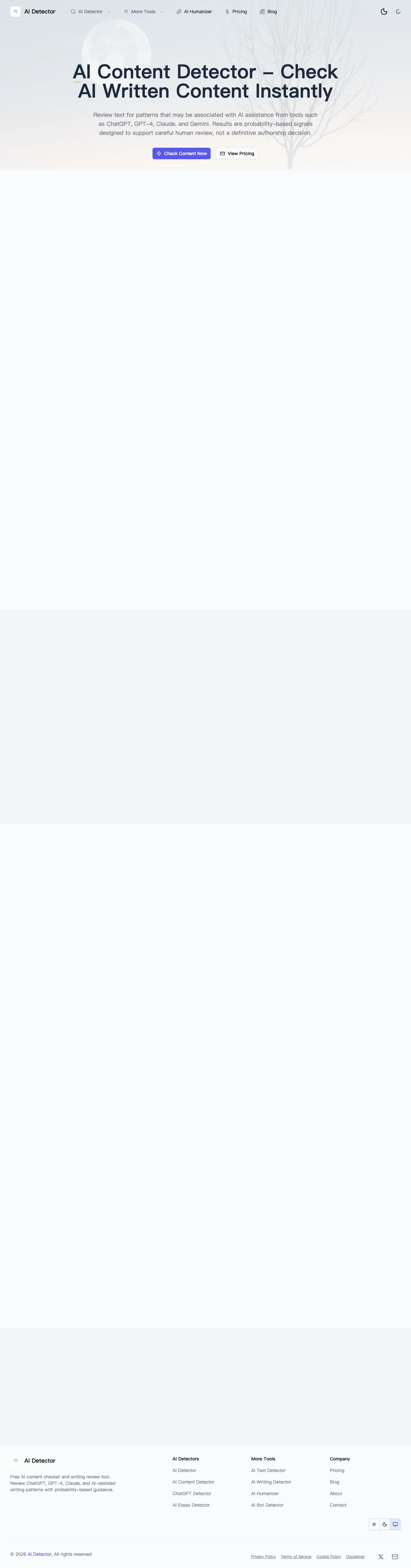
Product reference: the public AI Content Detector page captured on July 19, 2026.
Last reviewed: July 19, 2026 Use case: editorial intake for contributed articles, sponsored content, and staff drafts
Start with a transparent intake brief
Ask every contributor to declare the role of automation: research assistance, outline generation, language editing, translation, or draft generation. A declaration is not a punishment. It tells the editor where source checks and subject-matter review are most valuable.
The intake brief should include the intended audience, factual claims that need evidence, original reporting or first-hand experience, conflicts of interest, and the named editor who owns the final version. This is much stronger than asking a detector to adjudicate authorship after publication.
A review queue that preserves judgment
| Queue | Trigger | Editorial action |
|---|---|---|
| Standard edit | Clear sources and attributable reporting | Edit for clarity, accuracy, and audience fit |
| Source check | Broad claims, unnamed studies, or shaky citations | Open the primary source and confirm the claim |
| Voice review | Generic phrasing or abrupt tonal changes | Ask for examples, expertise, or first-hand detail |
| Escalated review | Potentially harmful factual error or plagiarism concern | Assign a second editor and document the decision |
A detector result can place a draft into “voice review,” but it should never bypass the other checks. Human-written copy can be generic; AI-assisted copy can include valuable reporting. The review must evaluate the work in front of the editor.
Worked example: replace a claim with evidence
Draft claim: “Most publishers now use AI detectors to guarantee that articles are authentic.”
This wording has two problems: “most” needs evidence, and “guarantee” is not a defensible editorial promise. A better version would name the specific workflow: “Our editors use source checks, contributor disclosures, and review signals to assess submissions.” It describes a real process and does not overstate what a detector can know.
Protect originality through reporting, not ornament
Original value comes from interviews, data, analysis, examples, and editorial choices that answer a reader's real question. Adding decorative adjectives to a summarized source does not make it original. Before publication, ask:
- What did this piece learn that a reader cannot get from the cited source alone?
- Which claims were independently checked?
- Is the author visible, and is their relevant experience clear?
- Could a reader identify the source material and the reasoning behind the conclusion?
Google's people-first content guidance makes the same practical distinction: content should add original information or analysis, show clear sourcing, and explain who created it and how it was produced when that context matters.
Publish an editing note when it helps readers
For reviews, investigations, or content that materially relies on automation, a brief note can improve trust: “This article was drafted with AI-assisted outlining and independently fact-checked by the editor.” Keep the wording factual. Do not use a disclosure as a substitute for fact-checking.