
AI can make a content team faster, but speed is not the same as quality. A reliable SEO process treats an AI-assisted draft as an editable input, then requires subject knowledge, source verification, and a reader-focused final check. Publishing large volumes of lightly changed output is a risk, not a strategy.
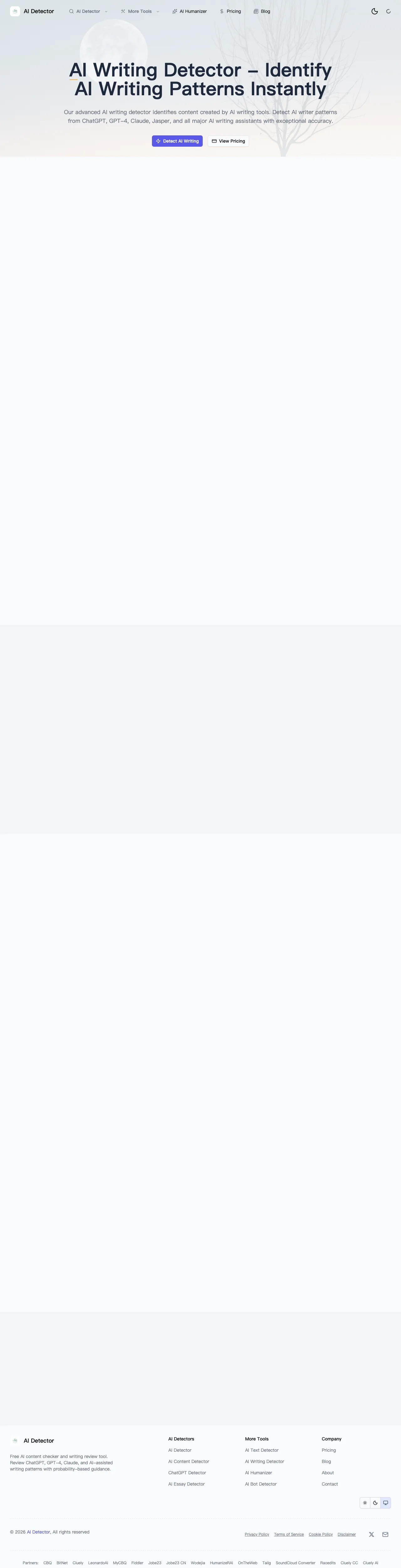
Product reference: the public AI Writing Detector page captured on July 19, 2026.
Last reviewed: July 19, 2026 Use case: marketing, documentation, and editorial teams reviewing an AI-assisted page before publication
The QA gate: answer the reader's task
Before discussing keywords, write one sentence that describes the reader's job: “A small publisher needs to decide how to review AI-assisted submissions without making unsupported accusations.” If a draft does not help that person make a better decision, it is not ready—even if it contains every target phrase.
Google's guidance explicitly favors helpful, reliable, people-first content. It asks whether a page provides original information, substantial value, clear sourcing, and first-hand expertise. It also warns against extensive automation used mainly to produce pages for search traffic.
A five-part pre-publication check
- Claim check: highlight every statistic, date, comparison, and “best” claim. Link each one to a primary or clearly named source.
- Experience check: add a tested workflow, screenshot, dataset description, or firsthand observation that a generic summary cannot provide.
- Intent check: remove filler paragraphs that restate the title without helping the reader act.
- Search-intent check: confirm the title and first section answer the question promised in the query.
- Accountability check: name the author or editorial team, add a review date, and disclose material automation when readers would reasonably want to know.
Worked example: turn keyword copy into a useful answer
Weak sample: “AI content detection is important for SEO because AI content is changing SEO. Use an AI detector for better SEO.”
The sample repeats a keyword but gives no decision rule. A stronger passage identifies the action: “Before publishing an AI-assisted draft, verify its factual claims, add original examples, and confirm it answers the reader's task. A detector can flag generic phrasing for editorial review, but it cannot establish search quality on its own.”
Use detection as a review signal, not a ranking shortcut
An AI-detection result may reveal writing that needs another editor's attention: a repeated structure, vague transitions, unsupported confidence, or a sudden shift in tone. That is useful for quality assurance. It does not tell Google whether a page is helpful, and it does not prove how the text was made.
For a content team, the right output is a review note such as: “Check the cited study and add an example from our product documentation.” That note creates a measurable editorial task.
Keep the release log small and useful
Store the publication date, reviewer, material sources, key changes, and any AI assistance that was substantial enough to disclose. This avoids “freshness theater,” where dates change without meaningful revisions, and makes later updates faster.